 Etherscan
 token approvals: spending limits, NFT permissions, and revocation
Updated on
Etherscan token approvals show which spender contracts can move tokens from a supported Ethereum wallet address and let the owner revoke those permissions. An ERC-20 allowance sets a spending limit for one token and spender. NFT permissions may cover one item or every item within a token contract, depending on the standard and approval type. Reviewing an address requires no wallet signature; removing permission changes blockchain state and costs gas. The relevant records identify the owner, token contract, spender, and current permission. These details distinguish a spending authorization from a token balance or a wallet connection.
Disconnecting an app leaves its token allowance unchanged; a successful revocation changes the permission stored in the token contract.
An approval enables spending without another wallet prompt
Once an approval takes effect, a spender can transfer tokens through the token contract within that permission. This supports swaps and other contract interactions that need tokens from an account. The token contract enforces the allowance; the approved application's own code determines when it requests a transfer. A legitimate spender may restrict execution to instructions from its users; malicious or compromised code can misuse the access that the token contract permits.
A conventional approval does not itself transfer tokens. It changes who can request a later transfer and the amount or token scope that the permission covers.
Reading the owner, token, and approved spender
An approval record describes a relationship within a particular token contract: the owner supplies tokens, and the spender receives authority to move them. The token contract stores the permission for the owner and spender addresses. Names and icons may help identify a record, but complete addresses distinguish contracts that use similar labels. The network also matters: a permission on Ethereum does not automatically create the same permission on another chain, even when the addresses are identical.
Etherscan distinguishes the original allowance from the current allowance. The first records the amount granted at the relevant approval, while the second describes the remaining permission. Spending or a later approval can change it. The readable amount follows the token's decimal convention; a direct allowance read returns contract units. Neither figure proves how many tokens the owner currently holds.
ERC-20 limits, NFT approvals, and multi-token permissions
An ERC-20 spending limit controls a token quantity. ERC-721 supports item approvals and collection-wide operators; ERC-1155 operator approvals cover all the owner's token IDs within that contract.
ERC-20 spending caps
For ERC-20,
allowance(owner, spender)
reports the remaining quantity that the spender may transfer. Execution also requires enough tokens in the owner's balance. A large allowance does not create a balance, and a token's transfer restrictions can block a transfer despite sufficient permission.
ERC-721 and ERC-1155 permission scope
ERC-721 item and collection approvals
ERC-721 permits approval of a particular token ID through
approve, and
getApproved
identifies that item's approved address. Ownership transfers clear this individual permission. Collection-wide access uses
setApprovalForAll, which authorizes an operator for the owner's NFTs within that contract. Clearing an item-specific approval and disabling an operator address different permissions; one action does not necessarily remove the other.
ERC-1155 operator approvals
An ERC-1155 operator approval covers all token IDs that the owner holds within that token contract, whether they represent fungible or non-fungible tokens.
The standard
setApprovalForAll
interface uses an enabled or disabled flag, without a separate quantity limit for each item. A contract may add narrower permission mechanisms through extensions. The base operator flag therefore needs a different interpretation from an ERC-20 spending cap.
Can I inspect approvals without connecting my wallet?
Yes, Etherscan's Token Approval Checker accepts a supported wallet address for inspection without connecting a wallet. It does not support contract addresses. Reading those records does not require a seed phrase, private key, or transaction. Revocation requires authorization from the account that granted the approval, normally through its connected wallet. A wallet connection alone does not grant Etherscan a token allowance. Any subsequent transaction request carries its own contract target and parameters, which determine what the account authorizes.
Revocation changes permission inside the token contract
For a conventional ERC-20 allowance, revocation sets the chosen spender's allowance to zero through
approve(spender, 0). Operator revocation for ERC-721 and ERC-1155 uses
setApprovalForAll(operator, false). ERC-721 item-specific revocation instead clears the approved address for that token ID.
The transaction targets the token contract that stores the permission. For ERC-20 and operator revocations, the spender or operator parameter identifies the address that loses access.
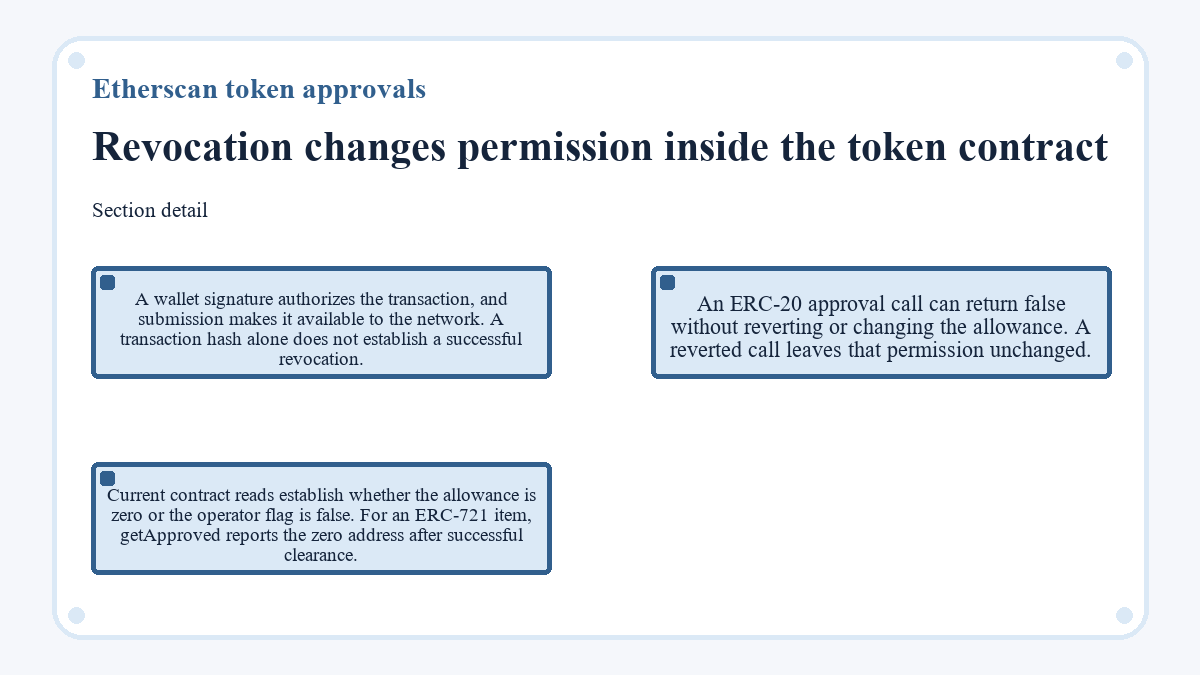
A wallet signature authorizes the transaction, and submission makes it available to the network. A transaction hash alone does not establish a successful revocation. An ERC-20 approval call can return false without reverting or changing the allowance. A reverted call leaves that permission unchanged. Current contract reads establish whether the allowance is zero or the operator flag is false. For an ERC-721 item,
getApproved
reports the zero address after successful clearance.
A pending revocation leaves the previous allowance available until execution changes it. A spender may act first, and a later revocation cannot reverse tokens that already moved.
Replacing a nonzero allowance with another nonzero amount introduces a related ordering risk. A spender may use the old limit before the replacement and then use the new limit. Clearing the old allowance, confirming that it is zero, and then granting a new amount avoids granting a replacement while the old allowance remains active. Spending that occurs before the clearing transaction still counts.
Gas costs follow execution and network pricing
The Ethereum transaction fee follows gas used multiplied by the effective price per gas. Token contract behavior and the storage change affect gas usage; network fees affect the price. Ethereum's execution fee does not take a percentage of the approved token value. A normal owner-submitted transaction needs sufficient ETH to cover its fee. The wallet's estimate describes that transaction under the current fee conditions, so no single token balance implies a fixed gas cost.
Reducing a limit or removing access
Suppose an existing ERC-20 allowance exceeds the amount needed for the next intended interaction. If the spender still needs access, a smaller allowance can preserve that use. If it no longer needs access, a zero allowance removes that permission. Both changes require contract execution and incur gas.
- Match the owner, token contract, spender, and network before choosing the permission to change.
- Keep a nonzero limit only when the intended interaction still needs that spender's access.
- Compare the wallet's transaction estimate with the available ETH for gas.
- For a nonzero replacement, confirm the old allowance is zero before granting the new amount.
- Confirm the selected allowance value after successful execution; a pending transaction does not complete the change.
If a later interaction needs the revoked spender, restoring permission may add another approval transaction and network fee.
Do token approvals expire automatically?
Standard ERC-20 allowances and NFT operator permissions have no built-in expiry date. An allowance can remain after an account stops using the spender. A zero token balance does not necessarily clear it, so tokens that later arrive at the same address can fall within the remaining permission. Contract extensions may add expiry or other restrictions; those rules belong to that implementation. An old timestamp measures the age of an approval, without proving whether the permission still works.
Finite allowances ordinarily decrease as the spender uses them. Some implementations treat a maximum allowance as unlimited and leave it unchanged during transfers. Previous spending can therefore consume a finite permission without exhausting an unlimited one. The current allowance and the token's own rules establish the remaining access; an approval date alone cannot do that.
Signed permits and layered spending permissions
Permits inside the token contract
ERC-2612 lets a supporting ERC-20 token accept a signed permit that updates an allowance. The signed fields identify the owner, spender, amount, deadline, and nonce. Signing does not itself update the blockchain; a transaction must submit the valid permit, which another address can send and an application may combine with further contract actions in the same transaction.
An ERC-2612 permit deadline limits when the token contract can accept the signed authorization.
It does not itself expire the resulting allowance under the base permit standard. A successful permit call consumes the nonce, preventing reuse of that signature. A normal
approve
call does not consume that permit nonce, so revoking an allowance does not necessarily invalidate an unused permit that could later restore it.
Permissions through Permit2
Permit2 adds a separate spending layer above the token's ERC-20 allowance to the Permit2 contract. Its
AllowanceTransfer
module tracks limits and expiry for individual spenders;
SignatureTransfer
authorizes a one-time transfer through a signature. Both depend on the underlying token approval. Removing that token allowance blocks spending through it without erasing Permit2's separate permission records. Those permissions can matter again if the account restores the underlying approval.
Etherscan token approvals: questions and answers
Can a spender send approved tokens to a different recipient?
A standard ERC-20 allowance identifies the spender and amount, without fixing the transfer's recipient. The transferFrom function takes a recipient address separately. The spender contract may impose its own routing restrictions, so the destinations it can use depend on that code. The approval record alone does not establish that transfers must return to the spender's address.
Does Etherscan's approval checker support smart contract wallet addresses?
Etherscan's Token Approval Checker does not support contract addresses. A smart contract wallet can hold tokens and grant permissions, but changes must follow that wallet's authorization mechanism through a compatible interface. Connecting the owner's separate address alone does not revoke permissions that belong to the wallet contract. The account that granted the approval remains the relevant owner.
Why does Etherscan show approvals for tokens I no longer hold?
Etherscan can include approvals for tokens that the address no longer holds when its Show All Approvals filter includes previously granted permissions. Such a record describes an authorization, not a positive balance. The original approval may still appear even when the current allowance differs, so the current permission remains the relevant value.
Is gas charged when a revocation transaction reverts?
A revocation that executes on Ethereum and then reverts still incurs a charge for the gas used. The revert rolls back the attempted permission change, so paying that fee does not prove that access ended. A rejected wallet prompt or a transaction that never executes on-chain does not incur that execution charge.
What happens to tokens already deposited in a contract after revocation?
Revoking your wallet's allowance does not withdraw tokens that already sit in another contract. That allowance governs transfers from the address that granted it. A completed deposit has changed the location or ownership of the transferred tokens. Withdrawing the deposit requires the receiving protocol's withdrawal or redemption mechanism, subject to its own rules.
Will revoking an approval cancel a signed NFT sale order?
Revocation removes a token permission without automatically cancelling a separately signed sale order. It may prevent fulfillment when the marketplace requires that permission to transfer the NFT. An order can remain valid under its own terms, however, and restoring the necessary approval may make it executable again. Order cancellation and approval revocation change different contract state.
Do contract verification badges prove that an approved spender is safe?
A contract verification badge does not establish that a spender will use its token permissions safely. Verification concerns correspondence between published source code and deployed code. The spender's behavior, permission scope, and any relevant upgrade controls determine what that contract can do.
Could an ERC-20 approval allow a spender to take native ETH?
An ordinary ERC-20 allowance does not authorize transfers of native ETH from the approving account. It governs the balance within the specific ERC-20 token contract. Other transactions, signatures, or account-level authorizations may affect ETH separately. Reviewing a token allowance therefore addresses that token's spending permission without establishing the account's wider permissions.